
This Days of Awe Trinity is meant to clean our slates for a new year. Psychologists and cognitive scientists have discovered how little free will we actually have; how the long, twisting, and convoluted set of antecedent experiences almost assures a single unalterable set of choices as laid out in Robert Sapolsky’s new book Determined: The Science of Life Without Free Will but with the evidence shared for decades in other works like Sam Harris’ Free Will.

The idea is that luck vastly outweighs any choice we might make, and that our lives, temperaments, and the paths we follow are all determined by not only our biology, but the sequence of circumstances in which we have happened to find ourselves. The main thrust of these arguments is about being more forgiving of our fellow reckless apes, who have vastly less control over their – and indeed we have over our own – misdeeds, than our moralistic philosophies imagine. I suspect these scientists understand that at the margins, there is some aspect of consciousness that is capable of pulling on the tiller or throwing pebbles beneath the wheels of the wobbling carriage of fate.
Ironic that in these days of the attention economy, despite this emerging understanding of human behavior, we are exhibiting an increasingly simplistic duality of blame, where un-nuanced guilt is assigned to one, and complete innocence to the other. Even more interesting, given these ideas about free will, is the implication for our collective will. Each of our interactions with our fellows then acts as one more antecedent in their behavior and theirs in ours, resulting in exquisite feedback with each and every individual’s choices.
These findings are part of a larger outgrowth of chaos theory, based on the phenomenon whereby miniscule differences in initial conditions can result in enormous differences in outcome. We now understand that the whole universe, including our earthly societies and even ourselves, are what are described as emergent phenomena, where large complex systems are not imposed by will, but rather emerge from the interaction of these myriad antecedents. Like the murmuration of larks or schooling of fish, no individual’s will, or even that of some collective unconsciousness, is responsible for creating these forms or collective behavior. Each bird makes small and seemingly inconsequential decisions, mostly in an effort to keep from running into the birds around it, with the forms of the flock emerging as an orderly collective behavior.
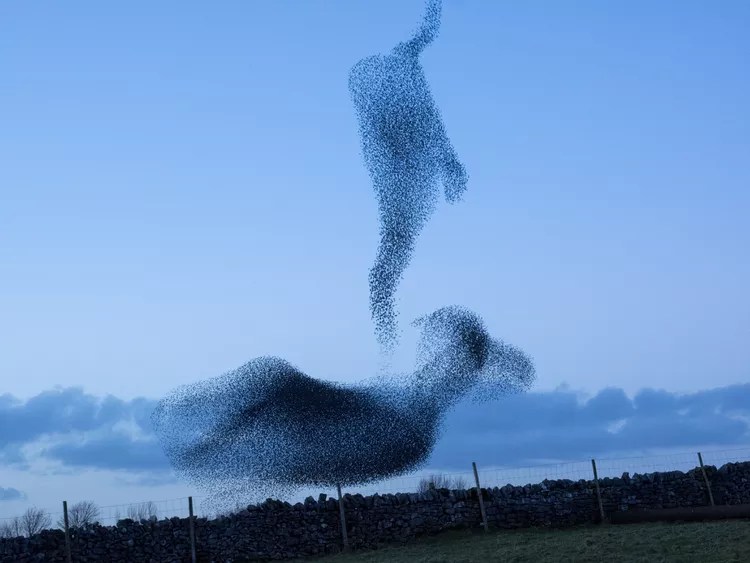
But none of this should make us less morally culpable. Every one of our words, thoughts, or deeds are part of this nearly infinite sea of antecedents creating the universe that emerges in the next moment. Our broad plans and schemes, now understood to be largely ineffective – merely fated by their history, become less significant than the myriad of infinitesimal ways we may collaborate to create the present condition we all find ourselves in.
Often, in relationships, we see ourselves as the victim of another’s unprovoked attack, and self-righteously react to defend ourselves. I have broken up countless fights between boys, each claiming the other “started it” and always being able to allocute the exact offense the other had committed to trigger their justifiable response. It’s always a cascade of tits for tats, with each tit escalating the previous tat. They can never agree on the original offense, and of course, most often these inciting incidents often have nothing to do with the particular conflict, but some other unrelated wound as simple as getting up on the wrong side of the bed (I suspect meaning retaining the emotional state of some bad dream) or residual anger over some parental injustice they were powerless to respond to. Trying to adjudicate the blame is often futile, and all we can say end up saying, “I don’t care who started it, just stop.”
I know in my own marriage I often felt that my wife attacked me for no reason at all, and she often accused me of the same. Sometimes the affront was in fact wholly unjustified in that moment, with the reason being some other lingering emotional state. Similar back-and-forths about who is to blame, who started it, who needs to apologize to whom, and who deserves to pout are generally in vain. The truth is, in almost every conflict the blame is actually shared in some proportion. The no-reason reason may be that one was aloof the day before, that the other overreacted to an unintended slight. The key is that no matter if one’s share of the blame is only 1%, we have 100% control over that 1%, which may be the straw that breaks the relationship’s back.
It can be pretty hard to step up and accept any blame, let alone for such minor and fractional guilt. These Days of Awe, with their themes of Atonement, Forgiveness, and Redemption here in the close of Holly Days, the beginning of the new year, and in the Judaic traditions of Yom Kippur and Rosh Hashanah, seem key to maintaining strong relationships, individual or collective. If we could all learn to step up easily and apologetically to take responsibility and atone for our roles, however minor, in small and shared conflicts, and forgive ourselves and each other for our inevitable missteps and transgressions, I wonder if we could eventually redeem the world, tikkun olam.

 HOLLY DAYS