
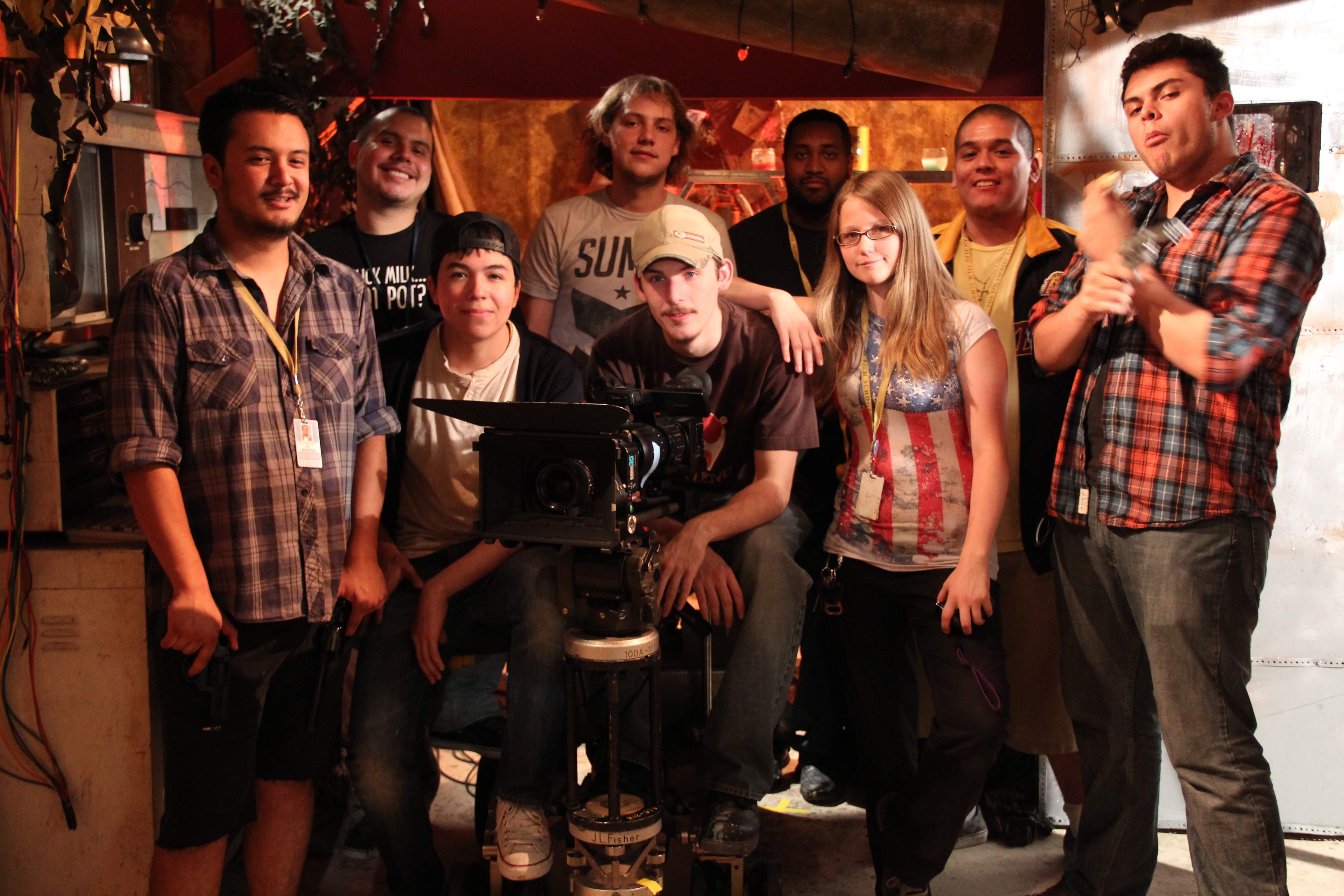

One of the most fulfilling jobs I’ve ever had was creating and teaching a film production course at an otherwise scammy for-profit film school. One of the many reasons I got fired was that I upset a group of christian students with my 2-3 hour opening lecture in which I described my own personal journey, as a lifelong atheist, to an understanding that the stories we tell can be more important to the unfolding of history than the lives we live .
I would explain why I believed that cinema – the most comprehensive and emotionally power artform humankind has ever devised – is fundamentally a process of crafting sacred myth, whether they liked it or not. I preached that as film makers, I expected them to be as gods, and take responsibility for the universe their movies would be helping to create. It was a hopelessly meta take that seemed completely sacrilegious and pointless to my less intellectually curious students, who frequently went to the administration to share their WTF’s.
For me, as with this Holly Days project, my main interest was in the essential (but wholly secular and physicalist) spiritual implications of our ideas and behaviors. Many decades ago, pondering the invention of communication satellites, I noticed that the major shifts in our spiritual paradigms, i.e. from animism, to polytheism, to monotheism, to deism, to pantheism etc all corresponded historically with major developments in communication culture and technology: from the invention of spoken language, to written language, to printing, then telegraph, radio and TV. I hypothesized that each shift, and especially the resulting explosion in the speed and extent of the collective mind’s network, demanded a reevaluation of the epistemology of meaning, adjusting the stories we share to make sense of what we see in the world. We’ve seen the increasingly rapid changes in our models of universe brought on by the scientific revolution disrupt the plot logic of the narratives from which religion has built its dogmas, traditions, rituals and communities. Nearly instantaneous wide-band global communications made possible by Telstar was beaming The Wizard of Oz, I Love Lucy, and Groucho Marx into the homes of every citizen on earth. I had no idea what effect that might have, but no doubt that it would lead to profound cultural transformations. The information superhighway did not yet exist when I first had this epiphany, but its development has clearly accelerated this transformation, surely landing us on the doorstep of another momentous shift in spiritual paradigms.

It’s become obvious to everyone that no brimstone-filled underworld lies beneath a smoking volcano, that no eternal paradise exists above the clouds. Even more fundamental features of the stories that have helped us make sense of our lives and given us hope for the future: the sure hand of a loving father at the helm, judgment in his kingdom of heaven, and the infallibility of our prophets and their scripture, while still recited with conviction and confidence, are now also straining the credulity of the plot. Whatever they may profess, most people just can’t sustain believing six impossible things every day before breakfast. This assertion of spiritual allegiance to fundamentally insupportable ideas, leaves a deep and confused undercurrent of nihilism hidden beneath even (perhaps especially) the most ardent evangelizers of any particular religious project. Complex and essential themes about the functions and values of our collective lives runs through all of our foundational narratives, and they too lose credibility as the details and logic of the plot become implausible. The result seems to be a pervasive cynicism, where only the most coarse and blunt forces of human interactions, hardwired into our lizard brains, remain in control, and value collapses simply into “Punch a Nazi”.
Yuval Harari, in his wonderful histories of our species: Sapiens and Nexus, makes a similar argument. Our dominion over the planet has only been made possible by these widely shared fictions, as calls them, of our myths and narratives. We can’t know what is coming, or what unexpected serendipity will lurch our planet’s history into a ditch or onto a fast track to the high road. While we seem to be in a period of spectacular disruption, I am certain that those of us who survive it will see it eventually settle into some new equilibrium as we find and share new, more convincing and nuanced stories whose plots feel true and resonant, and in which we will once again find meaning in our existence. Holly Days was borne out of this disruption. Our project is not to predict where we might arrive, but to join to contemplate our motivations and the more tenable plot points we are writing as we are all swept into the future together.
So, as my old prof Dr. Karenga (who inspired this hubris) would say, Heri za Umoja, Happy Unity, and Happy Holly Days!

 HOLLY DAYS